The right tire for your car —
and for Miami.
What fits your car, what we recommend for Florida roads, and the problems each brand's owners actually run into — by brand, from the cars we fit every week. No snow tires. This is Florida: our enemies are heat, rain and potholes.
Florida changes
the rules.
In most of the country, tread decides when a tire dies. In Florida, the calendar competes with the tread: heat and sun cook the rubber year-round, and a low-mileage car can need tires that still show plenty of tread — because the rubber has gone hard and fine cracks have opened in the sidewall. Read the DOT date on the sidewall (week and year of manufacture) and plan on about six years from that date here, whatever the tread says. Age is counted from the day the tire was made, not the day you bought it.
The test a Florida tire must pass is a summer downpour at highway speed: standing water on I-95, a flooded ramp, grooves full of rain. That is a wet-grip and tread-depth test. A tire at the legal minimum of 2/32″ can hydroplane exactly when you need it most — for Florida rain, 4/32″ is the line where replacement stops being optional. It is also the line the leasing companies measure against, which is why our Lease Return Inspection starts at the tires.
Tire pressure climbs as the day heats up and drops on the coolest mornings — which is when the TPMS light likes to visit. Check pressures cold, monthly, against the sticker on the driver's door jamb — never the number molded on the tire. And take under-inflation seriously on low-profile fitments: the air inside is the first cushion between a pothole and your wheel; run it low and the impact goes straight through to the metal.
The performance fitments most of our cars wear — short sidewalls, big diameters — look right and steer beautifully, and they are the first casualties of a Miami pothole. A bubble or bulge in the sidewall means the tire's structure is broken: that tire is replaced, never repaired, and the wheel underneath deserves a measurement too. Bent or cracked under the tire is exactly what our Luxury Wheel Repair exists for.
Read a tire
like a label.
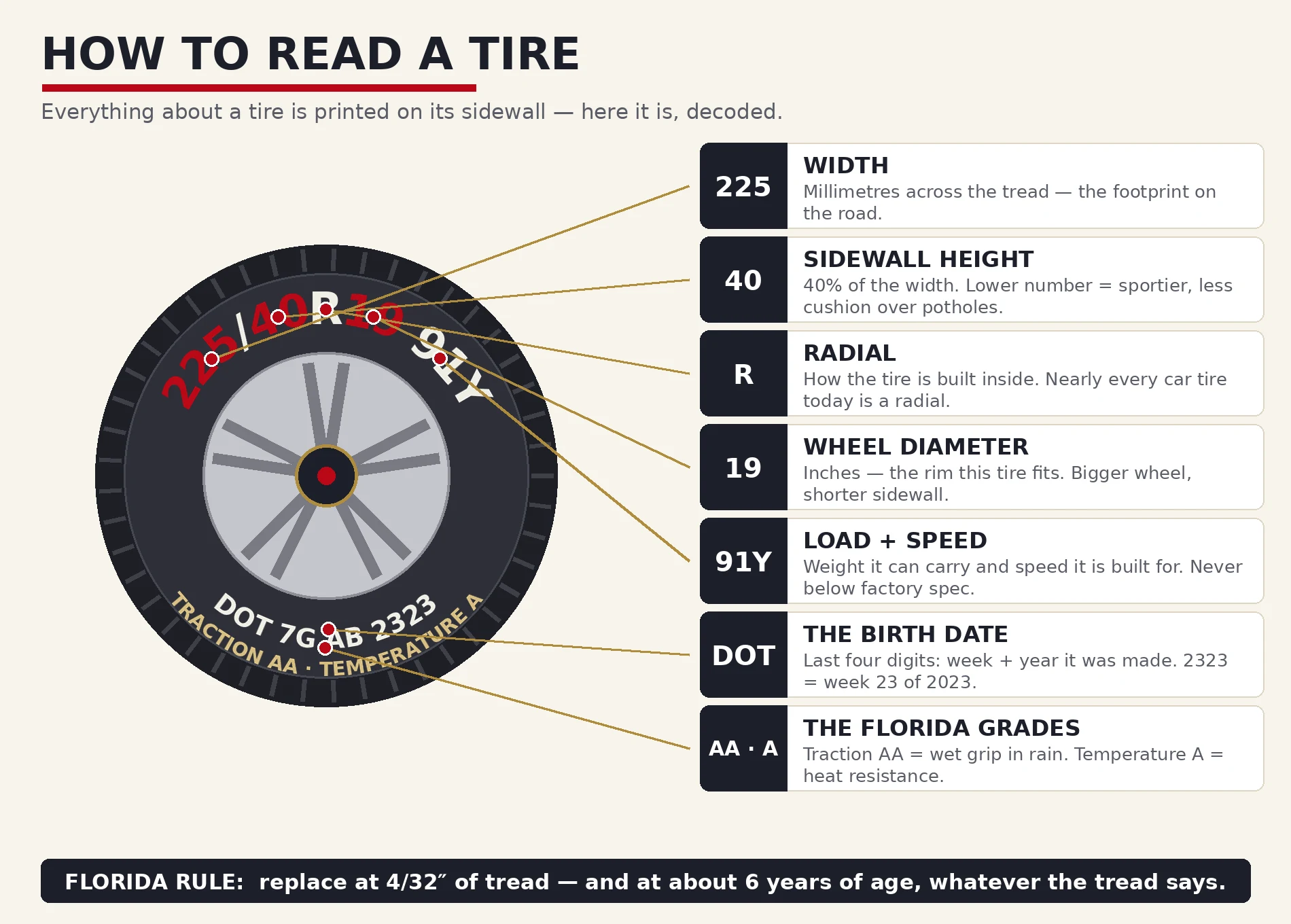
Everything a tire is, is printed on its sidewall. Take 225/40R19: 225 is the width in millimetres, 40 is the sidewall height as a percentage of that width, R is radial construction, and 19 is the wheel diameter in inches. After it comes the load index and speed rating — the pair your car was engineered around.
The numbers after the size (for example 91Y) say how much weight the tire carries and the speed it is built for. You may go up; you never go below what the car left the factory with. On the heavy SUVs — Range Rover, GLE, Levante, DBX — the load index is the line that matters most: an underrated tire on a two-and-a-half-ton SUV is a failure waiting for a hot highway.
Every tire carries treadwear, traction and temperature grades. In Florida, read the last two first: Traction AA or A is wet braking — our rain grade — and Temperature A is heat resistance, the grade a Miami summer tests daily. Treadwear is a relative wear index: a soft performance compound wears fast by design, and in this heat it wears faster.
New tires start around 10/32″. At 4/32″ the wet grip is already leaving and Florida rain starts winning; at 2/32″ the tire is legally bald. We measure at the lowest point of the tread, the way the leasing companies and the state measure — and the lowest point, not the average, is the number that decides.
The last four digits of the DOT code are the week and year the tire was built: 2319 is week 23 of 2019. A "new" tire that sat in a warehouse for three years is a three-year-old tire. Check the date on anything you are quoted — including, honestly, ours: we will show it to you.
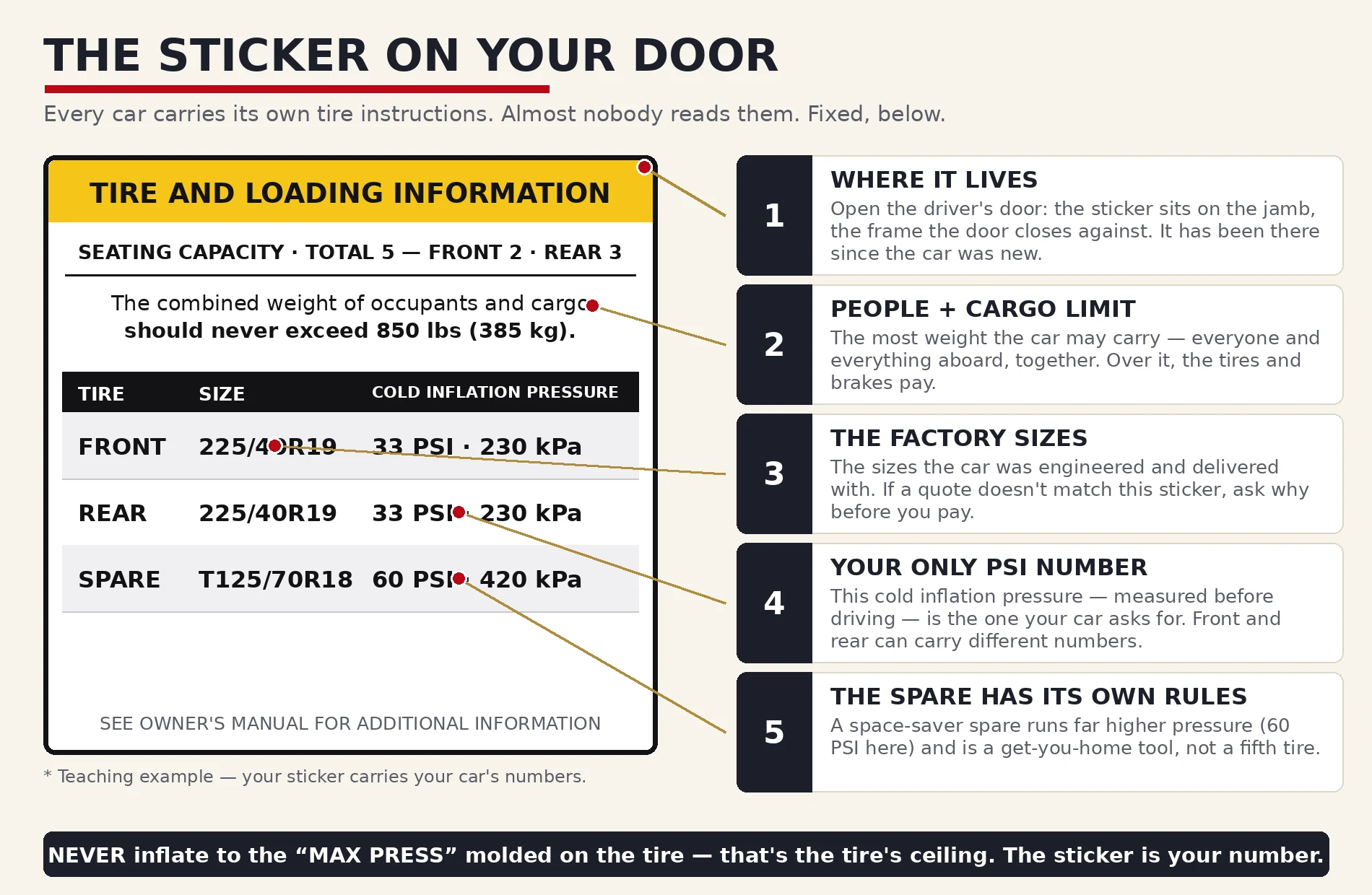
And the sticker on your door — decoded.
The pressures in this guide come from somewhere: the placard on your driver's door jamb. Owners look at it every day and read none of it — so here it is, line by line.
The house list —
what fits, what to watch.
The eleven brands we service, model years 2015 and forward. Sizes below are the fitments we fit most; your exact car is always verified against its door-jamb placard and factory specification before anything is quoted.
We fit most: Giulia 225/40R19 · Stelvio 235/55R19 · Tonale 235/45R19. Here: most Giulias arrive on run-flats with no spare — a mobility kit lives in the trunk instead. Quadrifoglio cars run a staggered setup: the rears work harder and wear first. Watch: run-flat sidewalls bubble after hard pothole hits, and a Giulia's alignment appetite shows up as inner-edge wear on the fronts long before the tread is gone.
We fit most: X3 245/50R19 · X5 staggered 275/40R21 front / 315/35R21 rear. Here: run-flats are standard fitment across most of the range, and xDrive cars want BMW's star-marked tires — the transfer case is sensitive to mismatched rolling diameters. Watch: staggered M setups eat rear inner edges, and run-flats crack and bubble on pothole strikes instead of just going flat.
We fit most: GLC 235/55R19 · GLE 275/50R20. Here: MO-marked tires are the factory specification; many models carry MOE run-flats and no spare. Watch: AMG staggered sets wear the rear inner shoulders quickly, and Mercedes front ends are alignment-sensitive — a fresh set deserves an alignment check the same visit, which is part of how we fit them.
We fit most: Q5 255/45R20. Here: the quattro rule rules everything: all four tires same make, model and near-equal tread depth, because the all-wheel-drive system reads diameter differences as slippage. Watch: one new tire beside three worn ones can strain the drivetrain — on a quattro, tires are a set decision, and shoulder wear from tired alignment is the other regular finding.
We fit most: Macan staggered 235/60R18 front / 255/55R18 rear. Here: Porsche's N-spec is a real engineering specification, not a marketing badge — N-rated tires are built and tested for these cars, and on 911s the rears do most of the work and wear at roughly twice the rate of the fronts. Watch: mixing N-spec with non-N on the same car unsettles the handling balance the factory tuned; keep the set coherent.
We fit most: Ghibli staggered 245/45R19 front / 275/40R19 rear · Levante 265/50R19. Here: the Ghibli's staggered set cannot rotate front-to-back, so rear tires are a wear item with a schedule, not a surprise. Watch: rear inner-edge wear is the Ghibli signature, and the Levante's weight makes its load index non-negotiable.
We fit most: Evoque 235/50R20. Here: these are heavy SUVs on large diameters — correct load index and an honest all-season with strong wet grip is the Florida recipe for the big Range Rovers and Defenders. Watch: weight plus Miami heat means faster wear than the same tire lives elsewhere, and all-terrain patterns trade wet-road manners and noise for the look — choose with the rain in mind.
We fit most: 245/75R17. Here: the one house brand that leaves the pavement: LT-rated tires carry the load and the sidewall strength for trail work, and bigger-than-stock fitments are a Wrangler tradition. Watch: oversizing changes gearing, speedometer reading and TPMS behaviour — a tire change on a Jeep is a small system, not a single part, and pressures for LT tires are set by load, not by habit.
We fit most: 500X 215/60R17 · 124 Spider on low-profile 17s. Here: modest sizes, honest prices — the Fiat family's tire story in Miami is age, not wear: low-mileage cars sit in the sun and the rubber times out with tread still showing. Watch: the Spider's low profiles share the pothole risks of every performance fitment on this page, in a lighter car that feels every hit.
We fit most: DBX staggered 285/40R22 front / 325/35R22 rear. Here: very wide, very specific fitments that are ordered in rather than shelved anywhere in Miami — plan a set ahead instead of shopping from a breakdown. Watch: soft performance compounds wear quickly in Florida heat, and at these widths the rear pair is a serious line item: alignment kept honest is money kept.
We fit most: the Urus on its big staggered fitments, 21 to 23 inches. Here: the fastest SUV on the page puts supercar torque through very wide rear rubber; the correct specification, matched as a set, is the whole conversation. Watch: availability — these sizes are ordered, measured in days, and a single damaged tire can mean a set decision because of the all-wheel-drive matching rule.
Fitments vary by trim, package and year — a Quadrifoglio is not a base Giulia, and an AMG is not a standard GLC. The placard on your driver's door jamb and the factory specification for your VIN decide. Send us the car, or read us the size off the sidewall, and the answer comes back exact — that verification is how we sell tires.
Rotation, alignment
& the matching rules.
On a square setup — same size front and rear — rotation evens the wear and stretches the set. On a staggered car (wider rears: Ghibli, X5, Macan, DBX, Quadrifoglio) front-to-back rotation does not exist; at most, side-to-side. Staggered owners buy rears on their own schedule — the honest plan is to budget for it, not to discover it.
quattro, xDrive, 4MATIC and the rest read the road through tire diameters. Keep the four tires the same make and model, at near-equal tread depths, and treat a single replacement as a measurement question: how far is the new tire's diameter from its three partners? Too far, and the drivetrain pays for the difference. This is also why a space-saver spare is a get-you-home tool, not a commute.
Inner-edge wear, a feathered tread, one tire aging faster than its partners — the tire is reporting an alignment or suspension fact. Miami potholes knock geometry out quietly. Fitting a fresh set onto a crooked car is buying the same wear twice, so alignment is checked as part of the fitting conversation here, not sold after the damage.
The warning light is information, not an annoyance — and its favourite Florida trick is the cool-morning visit: on at the first start, gone after a few miles. That is physics, not a sick sensor — the question below explains it. A light that stays on is pressure; a light that flashes for the first minute and then stays on is the system itself reporting a fault. Sensors are serviced while the tire is off and relearned to the car whenever a wheel has changed corner, as rule three below sets out; a light that returns after a proper set is telling you something else is wrong, usually a slow leak at a bead seat or valve.
Three rules.
Never skipped.
Change tires — or open the suspension or the steering — and the same three rules apply in this shop. They are not upsells and they are not optional: they are the difference between finished work and almost-finished work.
Every tire that goes on a wheel is balanced on the machine. An unbalanced wheel shakes at highway speed, cups the tread in scallops and hammers the suspension it rides on. “It felt fine” is not a measurement — the machine decides.
Touch the suspension or the steering — a tie rod, a control arm, a strut, a rack — and the geometry has moved, whether it looks it or not. And new tires fitted to a crooked car wear crooked from the first mile. Alignment is measured and set on the machine, never eyeballed.
The pressure sensors live in the wheels, and the car must know which sensor sits at which corner. Move a wheel to another corner, replace a sensor, or fit new tires, and the sensor positions are relearned to the car — through its drive cycle, a stationary procedure, or the TPMS tool at the diagnostic port — while cars that read pressure through the ABS are recalibrated instead. Sensors are serviced with fresh valve hardware while the tire is off, pressures are set cold to the door-jamb placard, and the system is verified reading all four corners before the car leaves.
When replacement
is the only answer.
A tire is the one thing we will never talk you out of replacing when it is done — it is the only part of the car that touches the road.
Sidewall damage of any kind: cuts, bubbles, bulges, exposed cord. Damage in the shoulder, where the tread meets the sidewall. A tire that has been run flat. Casing cracks from age and sun. None of these is a repair conversation; the structure of the tire is the thing that failed.
A nail or screw in the centre of the tread, caught early, is the classic repairable case — with the tire dismounted, inspected inside, and repaired with a proper plug-patch, never a rope plug from the outside. And in Florida the tread rule still applies afterwards: a repaired tire at 4/32″ is a tire at the end of its rain life.
Before you ask,
we answered.
For a performance car, a summer tire is the Miami answer: our winter is their season — maximum grip in the dry and the wet, exactly when our rain arrives. Take the first miles gently on the coldest January mornings, when any performance compound is stiffest. For a daily driver, a quality all-season trades a little of that edge for longer tread life and calm wet manners year-round. What neither car needs here is a winter tire: there is no snow in this story.
Two clocks run at once: mileage and age. A touring tire might carry 40,000–60,000 miles of tread; a performance compound, half that or less. But in Florida heat the age clock often rings first — plan on roughly six years from the DOT manufacture date, and let an inspection arbitrate: hardness, fine cracking and tread depth together decide, not any single number.
They do one job superbly: a punctured run-flat carries you up to about 50 miles at reduced speed instead of stranding you on the Palmetto at midnight. The costs are real too — a firmer ride, a higher price, and sidewalls that bubble rather than bend over a pothole. Many owners of cars that came on run-flats switch to conventional tires and carry a mobility kit; the one hard rule is a lease: a car that was born on run-flats goes back on run-flats.
Sometimes — it is a measurement, not a slogan. The new tire must match its axle partner in make, model and near-equal tread depth, and on all-wheel-drive cars all four diameters must stay close. When the other three are fresh, one matching tire is honest work. When they are half-worn, the honest answer is a pair — or a set — and we will show you the measurements behind whichever answer we give.
Only with a known history: a readable DOT date, honest tread depth, and an inspection for the damage a photo hides — patches, bead corrosion, sidewall repairs. That standard exists for a reason: a good used tire is a legitimate answer before a lease return, and it is part of how we correct tires on the Lease Return Inspection. An unknown-history tire at a too-good price is a stranger, and strangers are what inspections are for.
Because the corner of the car is telling on itself: toe and camber settings, a pothole's quiet geometry change, or the factory's own performance alignment on a staggered sports setup — several of our brands wear rear inner edges by design and by schedule. The tire is the messenger. Measuring the wear pattern and the alignment together is how the next set gets a longer life than the last one.
Physics, not a broken sensor. The air inside a tire contracts as it cools, and the pressure falls with it — roughly 1 PSI for every 10°F the temperature drops. Overnight is the coldest your tires ever get, so a tire that was already a few pounds low can slip under the warning threshold while the car sleeps — and the light is waiting for you at the first start. In Miami this arrives with the season’s cold fronts: a 30-degree swing costs about 3 PSI. Then you drive: the flexing tire warms its air back up, pressure climbs those few pounds, and the light goes out. Do not be fooled by the disappearing act — the tire is still low every cold morning, wearing its shoulders and working harder than it should. The fix holds no mystery: check and set the pressures cold — before driving, against the sticker on the driver’s door jamb, never the number molded on the tire. And if one tire is always lower than its sisters, it is not the weather: it has a slow leak, and it needs a look, not just air.
Book SERVIZIO
Written quotes, transparent diagnostics and honest service in Miami.
We confirm every booking personally.