A new wheel is one of the most expensive surprises —
and a single matching one is not always easy to find.
You heard the scrape before you saw it. One tight parking garage, one valet, one Miami curb — and the wheel that made your car is scarred. Here is the part nobody tells you: you almost never need a new one. We repair luxury wheels back to factory look — curb rash, bends, cracks, finishes — for a fraction of what the dealer charges for a replacement.
Every wheel is different. Damage, size and finish decide the work — we inspect it first and give you a clear, written quote before we touch it. Repairs start at $250+ per wheel — the exact figure is the one on your quote, never invented at the counter.
Replace it, or
repair it right.
You are buying a part — not a finished car. And the part is rarely there: the dealer almost never has your wheel in stock, so it gets ordered and the wait begins. Find one online instead and it is still a wheel in a box — about a week out by courier, next day at best, and pray it is the right one. Then, when it finally lands, the work has not even started: the tire still has to come off the old wheel and onto the new one, the TPMS sensor fitted, the wheel mounted and balanced, and the TPMS reprogrammed to the car. The part is the beginning of that story, not the end of it.
One written quote and one responsible party, from the moment the car comes in to the moment it drives out on its own wheels: tire dismounted, the wheel repaired and refinished, tire remounted, TPMS sensor fitted and reprogrammed to the car, balanced and checked. It is more than simply fixing a wheel — and it is all in the one quote, before we touch anything. Repairing the original also keeps the set matched and costs a fraction of replacement: your wheel, your car's original equipment, back to looking the way it left the showroom.
That is the difference: there, you buy a piece and the work is still ahead of you. Here, you buy the finished car.
Every way a wheel
gets hurt.
Miami is hard on wheels: tight garages, valet stands, potholes after the rain. This is the work we do every week.
The daily wound. The damaged metal is repaired, the surface rebuilt and the finish matched to factory — color, gloss and texture — so the repaired wheel belongs with the other three.
A bent wheel vibrates at speed, wears the tire unevenly and leaks air slowly — and the bend that matters is often on the inner barrel, where you cannot see it. We measure runout before we judge it, straighten what measures straightenable, and verify it runs true before it goes back on the car.
A pothole does not wound a wheel the way a curb does. The tire gets pinched between the edge of the hole and the wheel itself, and the force lands on the inner lip and barrel — the parts you cannot see from the sidewalk. One hit can leave a bent inner barrel, a hairline crack, a damaged valve, or a tire whose sidewall took the punch together with the wheel. After a hard hit we inspect the whole corner — wheel, tire and alignment — under one roof, because an impact rarely wounds just one of them.
A single short hairline crack in the inner barrel can usually be welded and restored. A crack in a spoke, in the hub or through a lug hole cannot — that wheel is replaced, not repaired, and no quote changes that. Every cracked wheel is inspected and measured before anyone promises anything; the full line is drawn in When we say no, below.
Full refinishing in the factory color, a new color altogether, or powder coating for a harder, longer-lasting finish. The custom colors Miami asks for most — gloss black, satin black, bronze and gunmetal — or the color in your head. One wheel matched to the set, or all four transformed.
Sometimes nothing hit the wheel — the finish itself gives up. Factory clear coat lifts and bubbles, and Miami's salt air creeps in underneath, turning bright metal cloudy and white at the edges. That is not a polishing problem; the finish has failed, and it keeps failing outward from every breach. The cure is the honest one: strip it to bare metal and refinish the wheel whole, before the corrosion moves from the finish into the metal itself.
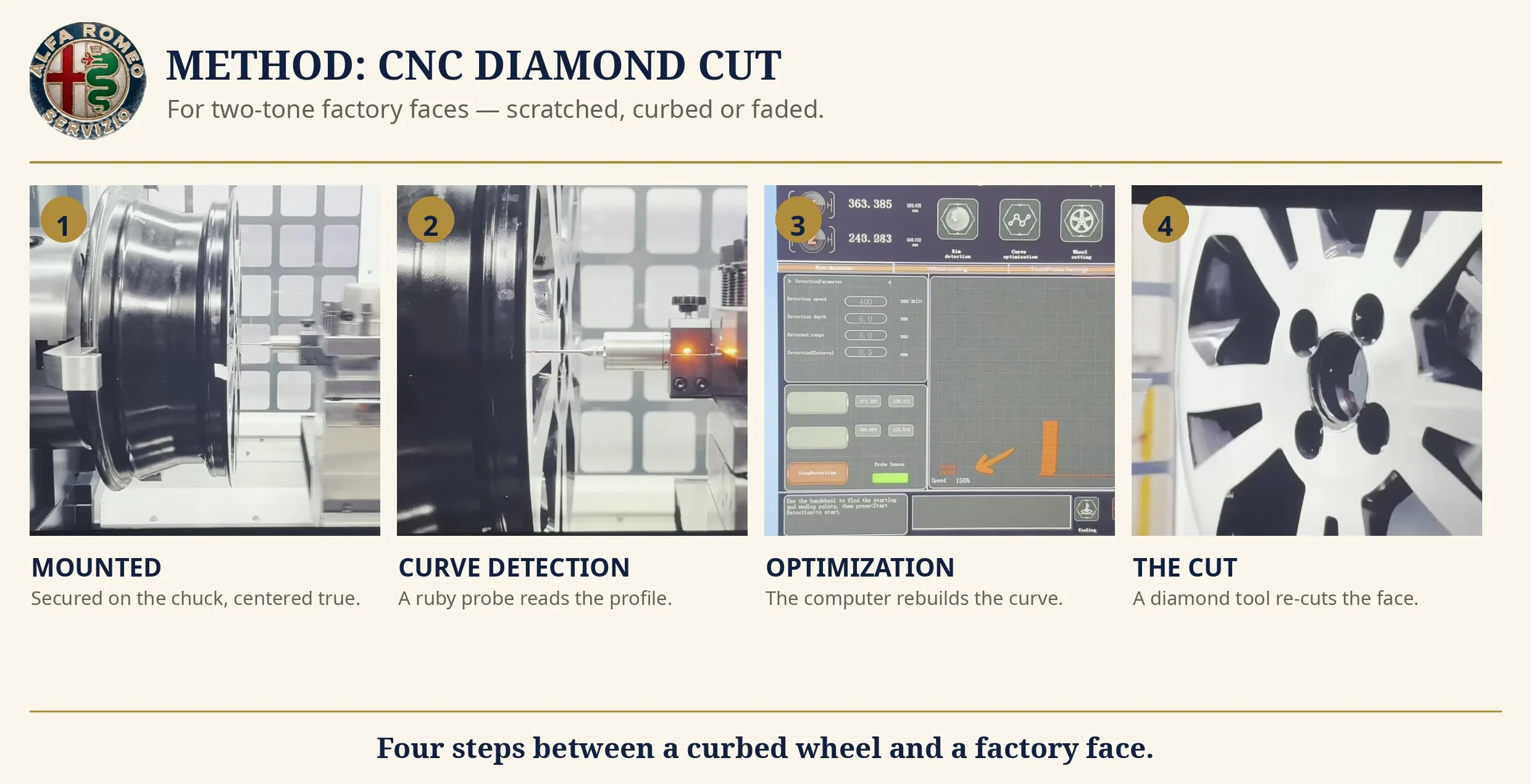
Diamond-cut faces, machined lips and polished finishes are the hardest to bring back — and the ones that separate a repair from a restoration. We restore the factory machining and the clear coat that protects it.
Every repaired wheel comes back mounted and balanced, with the tire inspected — and if the tire or its valve needs replacing, that is part of the same job, handled in the same visit. You do not leave with a pretty wheel and a vibration.
The car tells you first.
Learn its language.
Most wheel damage announces itself before it shows itself. The scrape you can see; the bend you feel. If any of these began after a pothole, a curb or a parking-garage wall, the wheel is the first suspect — and the gauge, not the guess, settles it.
The steering wheel starts to hum or shake at speed — often inside one speed band and calm outside it. That is the classic signature of a wheel knocked out of round: a bend, usually on the inner barrel, where the eye never goes. A balance alone cannot cure a vibration whose cause is shape.
You top it up, the warning light goes out, and days later the TPMS light is back. A slow leak with no nail anywhere in sight usually means air escaping where the tire seals against the wheel — a bead seat distorted by a bend — or breathing out through a hairline crack. Air you keep replacing is a message, not a chore.
A car that drifts to one side after an impact, or thumps once with every turn of the wheel, is describing damage in the corner that took the hit. Wheel, tire or alignment — the three are checked together here, because an impact rarely wounds just one of them.
Uneven wear — one edge, one tire, one corner — means something in that corner is no longer running true. It can be the alignment, and it can be a wheel bent just enough to scrub its tire away mile after mile. Either way, the measurement comes first: guessing parts at a symptom is how money gets wasted.
None of these proves the wheel is guilty. All of them earn it an inspection — and the inspection, with its written quote, costs you nothing.
Measured, stripped,
rebuilt — not touched up.
A proper wheel repair is a remanufacturing process, not a cosmetic cover-up. It runs on computerized measurement and machining, a professional paint booth and a curing chamber — the equipment a luxury wheel deserves, not guesswork and a spray can. This is the sequence every wheel goes through — and where each step can stop the job if the wheel does not pass.
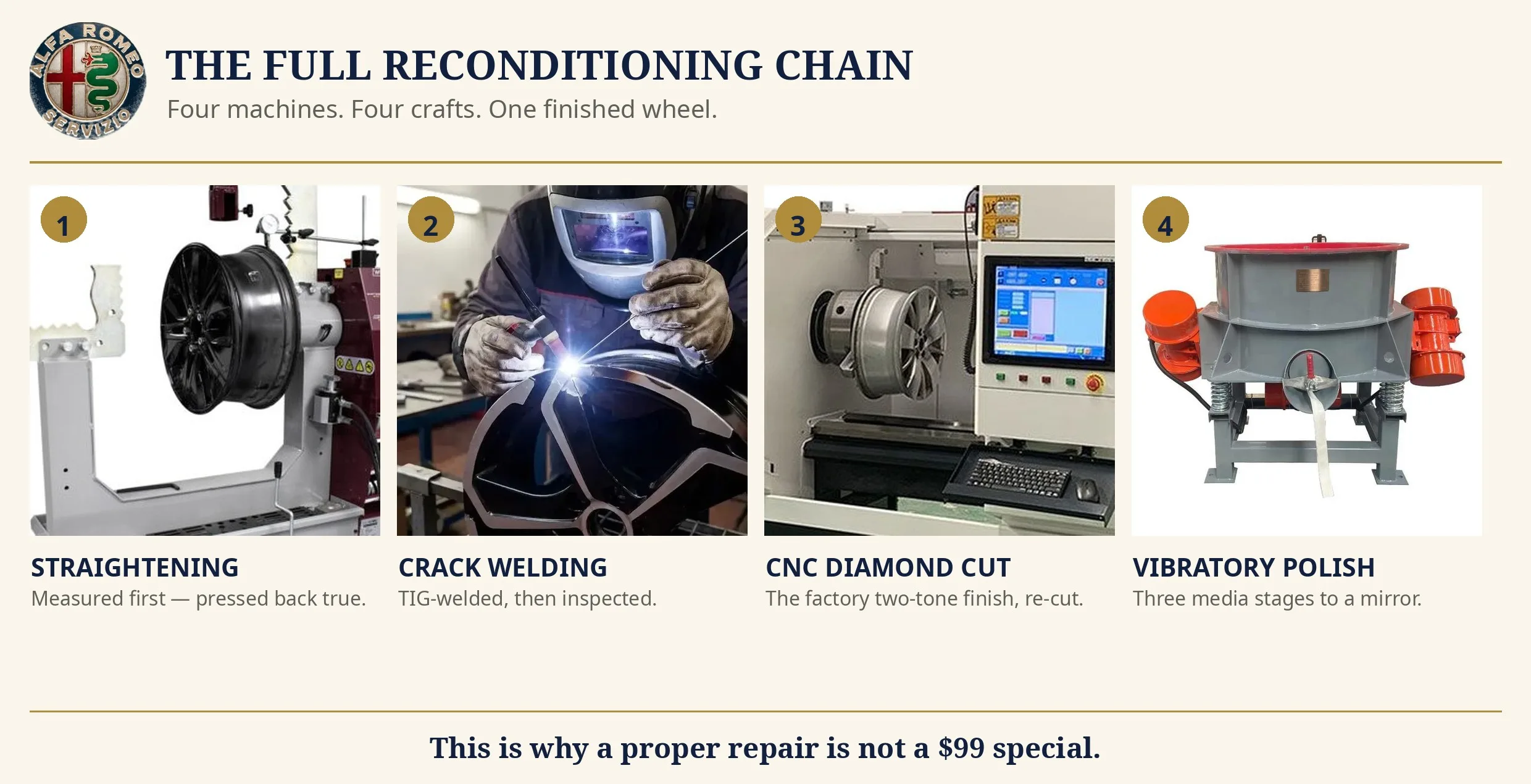
Some wheels are replaced.
Not repaired. Ever.
This is the section most shops would never publish. We publish it because the refusal is the proof: a shop that will say no to your money is a shop whose yes you can trust.
Cracks in a spoke. Cracks at the hub or center. Cracks through a lug hole. Multiple cracks, or cracks that intersect. Bends that will not hold a bead or will not come back within tolerance. Deep gouges taken out of a spoke. Severe corrosion that has eaten the metal itself. Those wheels are done — and welding them anyway is how people get hurt.
We tell you straight, we show you what the inspection found, and we help you source the correct replacement — right diameter, width, offset and finish for your car. You lose a wheel, not your trust in the answer.
What you will never hear from us is "good as new" as a slogan. What you get instead is a wheel that was inspected, measured, brought back within tolerance, and balanced. The repairable core is real but narrow: cosmetic damage, honest bends, and a single short hairline crack in the inner barrel. Everything else is a replacement conversation, held honestly.
Handing us a wheel starts an inspection — it is not a promise that the wheel can be repaired, and we will not dress it up as one. At a glance, plenty of wheels look fixable; the truth comes out only on the measuring equipment. Nor will the risk reach you late: the wheel is read on our own machines the moment it arrives, and when that first read already looks bad, we set the expectations at the door — this wheel is heavily affected, there is a real chance it may not be repairable, and we will try. So if the final verdict is no, it lands as news you were prepared for; and if the wheel comes back repaired, it lands as the good surprise. If yours measures beyond the safe line — too hard a hit, too deep a twist or deflection, too long a crack, or any condition that could fail out on the road — the answer is no, we tell you to your face, and the wheel goes back to you exactly as it came in. The inspection costs nothing. The written quote costs nothing. And a wheel we refuse costs nothing: if it can't be fixed, it can't be fixed — returned, no charge.
There is an Alfa Romeo wheel here right now that is this section, in metal. It is an expensive wheel, and to the eye it is spectacular — it looks like it just came out of the dealer, brand new. The measuring equipment says otherwise: it carries a deviation that could not be corrected, and mounted on a car, that car would ride as if it were on a horse. We could sell that wheel; it looks perfect. We will not sell it, and we will not mount it. It stays here as the lesson it taught us: the eye says new — the machine says no.
Know your finish.
We'll tell you its weakness too.
Primer, factory color, clear — the classic system, and the easiest route to an exact color match. It is also where matching becomes a discipline: the bright, multi-stage silvers that BMW and Mercedes made the hardest exam in the trade are not a color but a construction — fine metallic flake that has to lie at the right orientation, at the right depth, under the right clear. Most shops get them visibly wrong: too dark, too coarse, bright from one angle and dead from another. Matched stage by stage, they land. A good finish; simply not the hardest one we offer.
Dry powder applied electrostatically and cured in a professional curing chamber into one continuous skin. The most durable finish of the family — the strongest answer to chips, corrosion and Miami sun. Its one honesty note: a deep chip usually means recoating the whole wheel, not a spot fix.
The prettiest — and the most delicate. A bright machined face under a thin clear coat: one chip lets water under that clear, and the finish turns milky as corrosion creeps beneath it. It cannot be touched up, only re-cut — and a wheel can only be re-cut once or twice in its life before the face has given up too much metal.
Bare aluminum buffed to a near-mirror shine. Beautiful, and it can be re-polished back to glory — but unprotected polished metal oxidizes, so it asks for regular care. This is the high-maintenance finish, and we say so before you choose it.
Colored pockets with a machined or polished face — a combination, not a material. It ages at the speed of its weakest element, which is almost always the clear over the bright face. We restore both halves of the design, and we will tell you which half will need you first.
Chrome is electroplating — layers of copper, nickel and chromium — not a coating we can spray back on. We do not re-chrome wheels, and we will not pretend a paint is chrome. If your wheel is chrome and tired, the honest options are a specialist plating conversation or converting the set to a finish we can stand behind.
How it's built
decides how it breaks.
Molten aluminum poured into a mold — the standard factory wheel, and the heaviest of the three. Cast metal is honest, but porous by nature: on a fair hit it bends, on a hard one it can crack. Most wheels we repair are cast — and most cast damage is repairable damage.
Born cast, then spun and stretched under pressure while hot, which tightens the metal's grain exactly where the barrel needs it most. Lighter and stronger than a plain casting — the middle ground many modern performance wheels live on, and usually repairable under the same discipline.
Pressed from a solid billet of aluminum under enormous force — the densest, lightest and strongest construction of the three. Forged wheels shrug off hits that wreck cast ones. But when a forged wheel does crack, its inspection is the strictest of all: the forces it survived are written deeper in the metal.
Construction decides the verdict as much as the damage does. That is why the inspection — and the measurement — always comes before the quote.
Four steps.
No surprises.
Drive in with the damage on the car, and we handle everything from there. Rather bring the wheel on its own? That works too — a loose wheel gets the same measured inspection and the same written quote.
It starts on our own equipment: before anything else happens, the wheel goes on our mounting and balancing machines and we watch how it runs — a first read, taken at intake and written down. If that first spin already shows a wheel that is heavily distorted, you hear it from us right there, in plain words: this wheel is badly affected, there is a real chance it cannot be repaired, and we will try. The expectations are set at the door, not discovered at the end. And a first read is only a first read — the verdict itself comes from the full measurement that follows. The inspection and the written quote cost you nothing, and the straight answer comes first, including when the right answer is a new wheel.
It starts with a photo of the damage. Every wheel is different — damage, size and finish decide the work. Repairs start at $250+ per wheel. The exact price is written on your quote before we touch the wheel — you approve it before any work begins.
Repaired and refinished, then mounted and balanced and checked on the car. The delivery time is confirmed in writing in the quote for your wheel.
3970 NW 27th St, Miami, FL 33142 · Mon–Fri 7 AM–1 PM / 2–5 PM · Sat 8 AM–4 PM · Sun closed · (305) 871-5551
What stands behind the repair?
Ask us.
Every wheel is different, and so is what stands behind its repair. Ask us — we explain it face to face, and put it in writing on your quote, before any work begins. The explanation comes first, while the decision is still yours.
Luxury wheels,
every day.
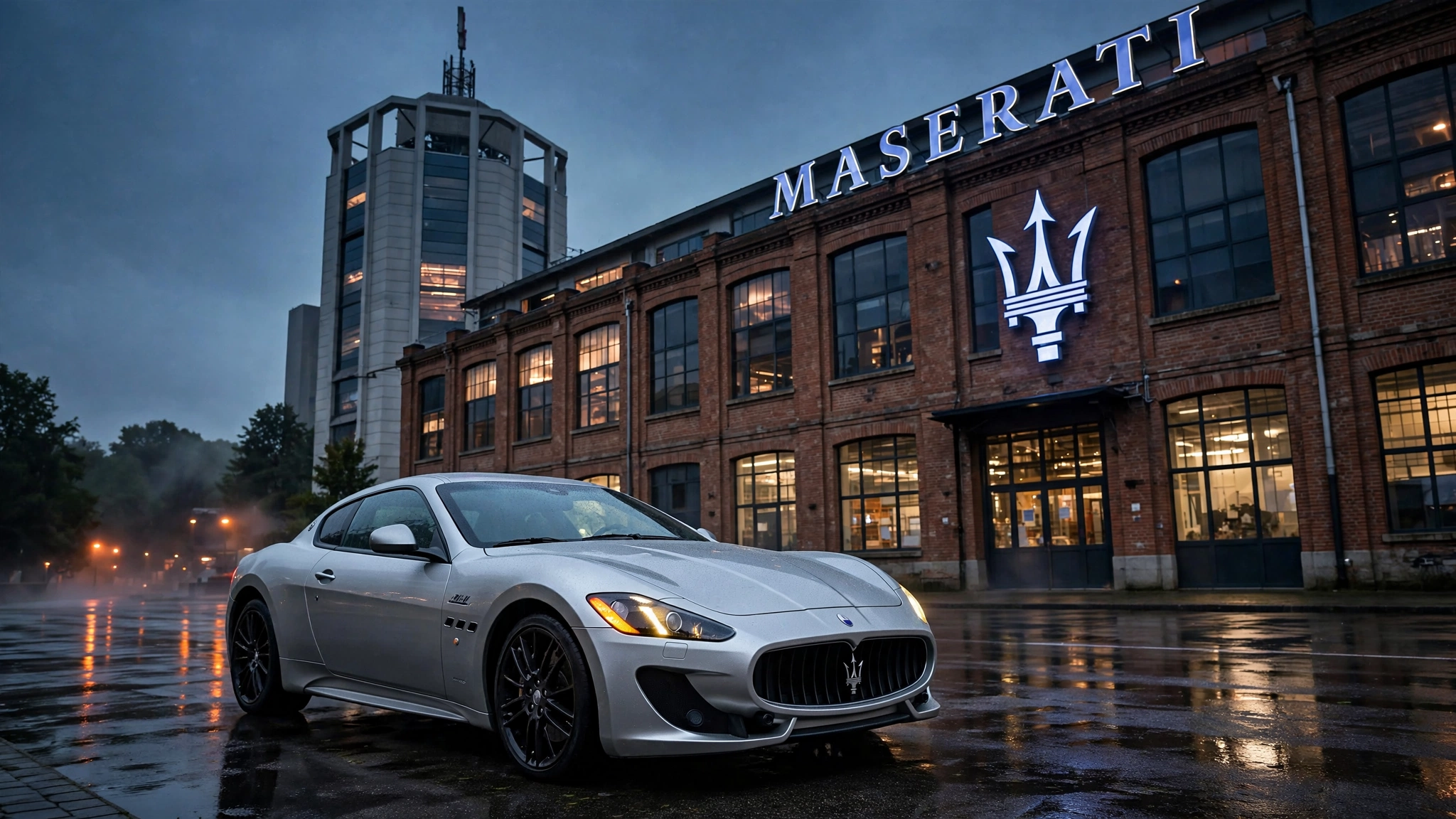
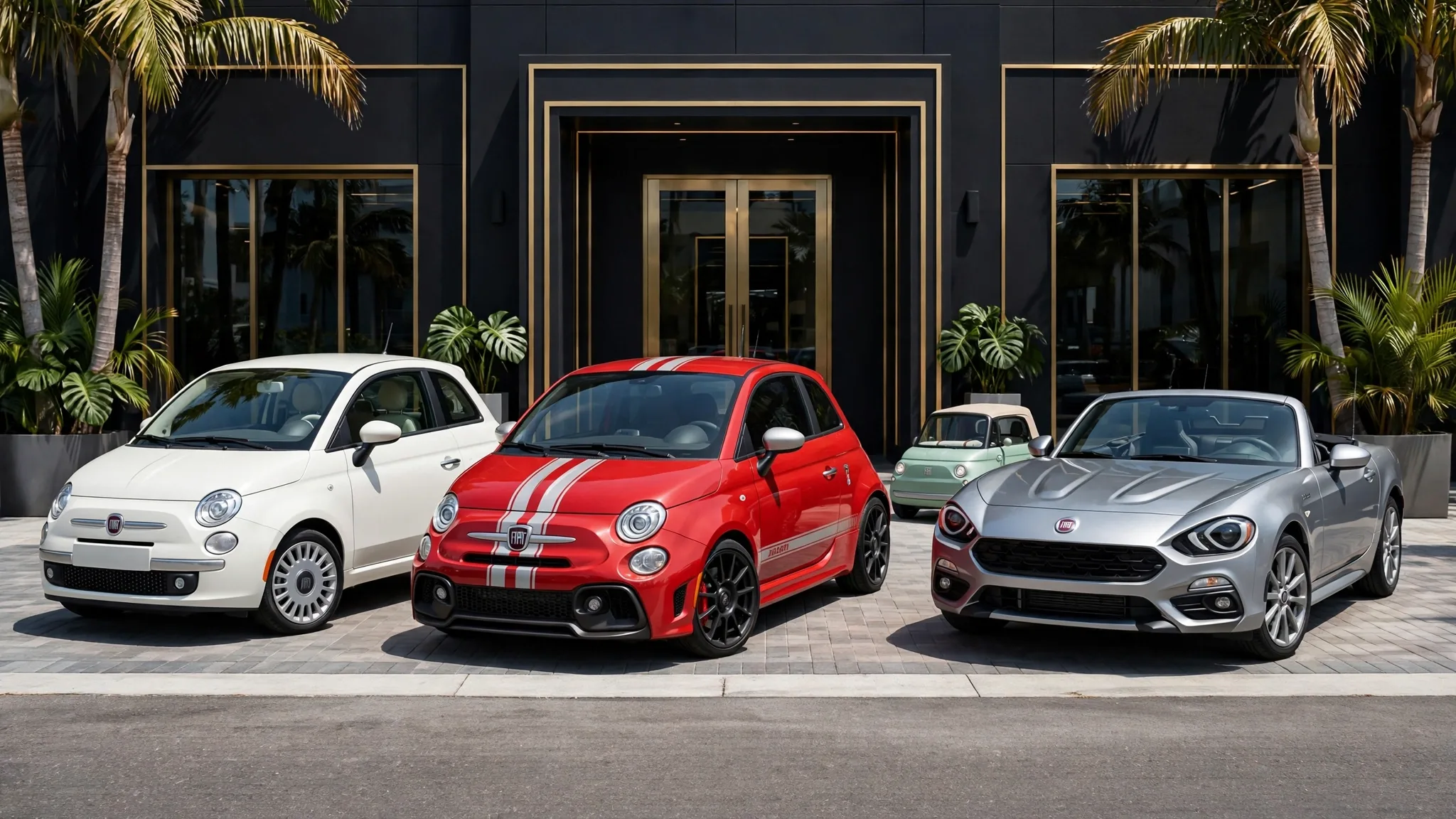
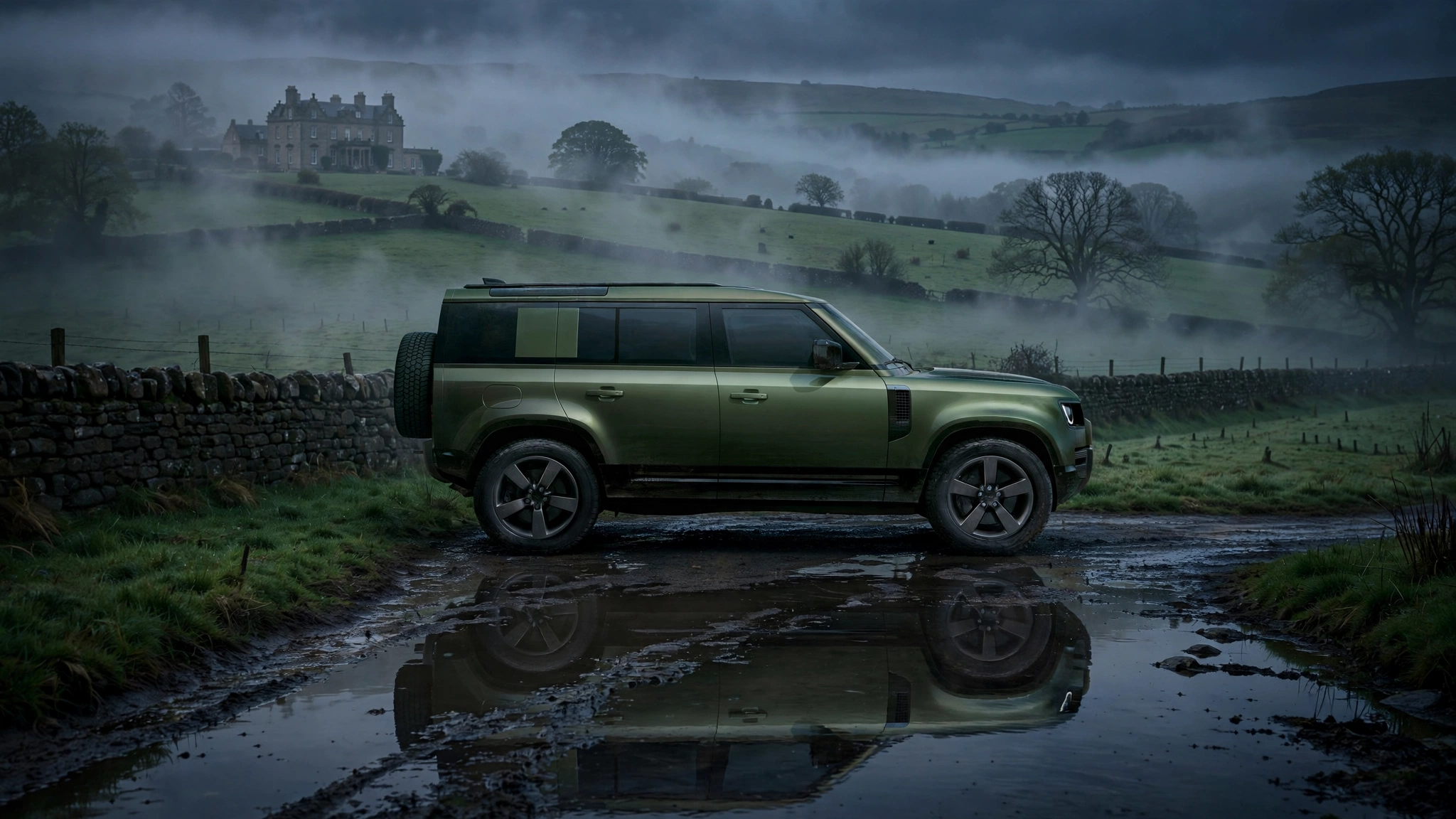
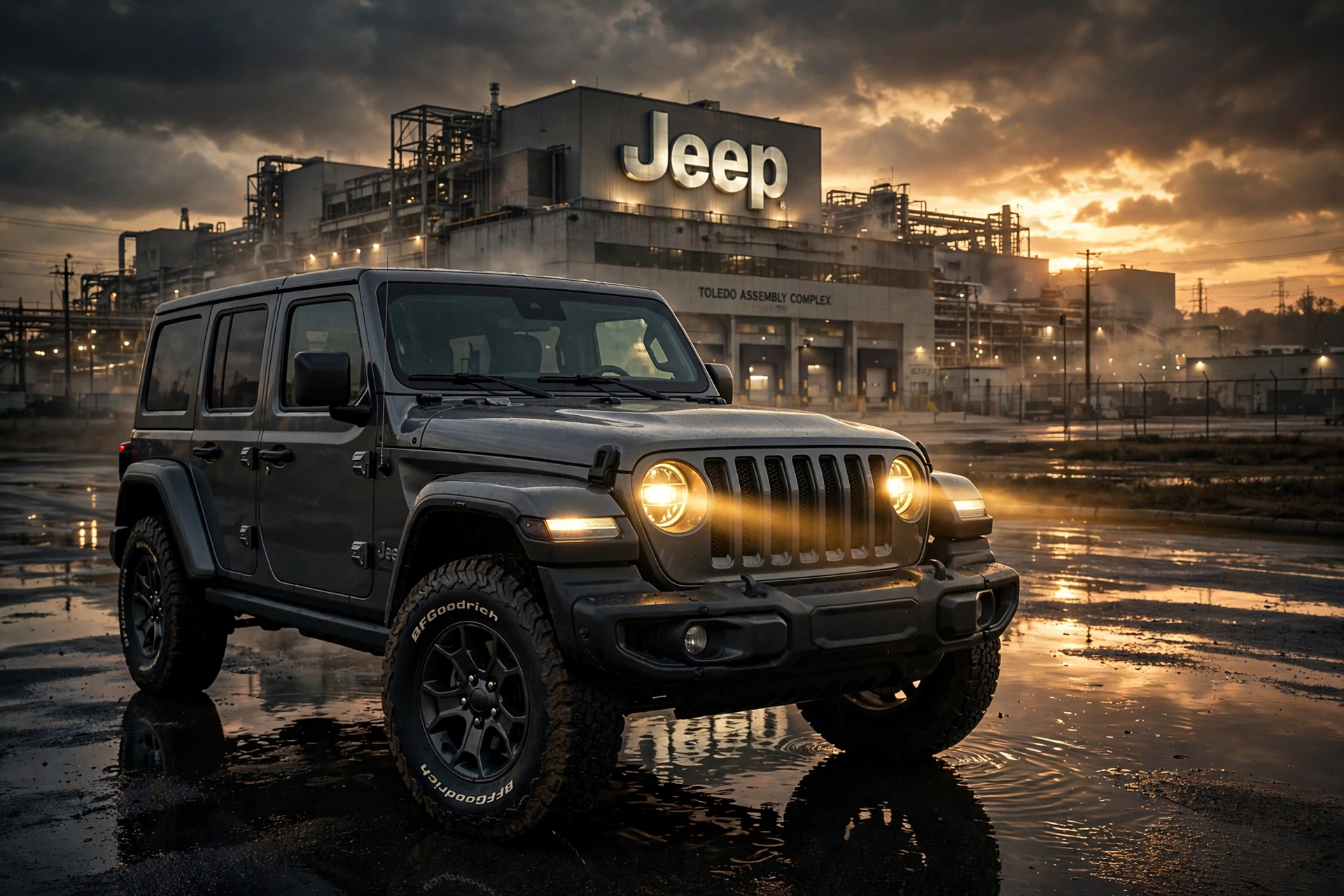
The wheels we repair most are Alfa Romeo and BMW — the dark-finish Giulia and Stelvio wheels, the big M wheels — but the bench sees the whole house: Maserati, Fiat & Abarth, Jeep Wrangler & Gladiator, Porsche, Mercedes-Benz, Audi, Land Rover, Aston Martin and the Lamborghini Urus. Factory finishes, forged and flow-formed wheels, diamond-cut and two-tone designs included. If your car wears it, we can repair it.
Returning a leased car? A curbed wheel is one of the first things the leasing company's inspector bills — repairing it first is part of our Lease Return Inspection.
Before you ask,
we answered.
It is — when the wheel is honestly repairable. And it is not, when it is not. That is why the inspection and the measurement come first here, and any promise comes after. Cosmetic damage, honest bends and a single short hairline crack in the inner barrel sit inside the safe core: a wheel repaired inside that core, brought back within tolerance and balanced, is a wheel you can drive on with a clear head. What is not safe is repairing the wheels in When we say no — cracks in a spoke, at the hub or through a lug hole, multiple cracks, bends that will not come true. Those we refuse, and the refusal is the safety system. A shop that repairs everything is not braver than we are; it is only quieter about the risk.
Matching the factory finish is the standard work — but know that "the factory finish" is not always one coat of one color. The hardest test in this trade is the bright multi-stage silver: the hyper silvers on BMW and Mercedes wheels and their rivals are a construction, not a color — a fine metallic base whose flake has to lie at the same orientation the factory laid it, tinted stages over it, and clear at the factory's depth. Sprayed as a single ordinary coat, they come out too dark, too grainy, or they flip wrong in the light. We match them stage by stage, judged against the wheel that will sit beside yours — because the real judge is never the paint code; it is the other three wheels on your car. One honest caveat on top of that: your other wheels have aged in the Miami sun, so a fresh wheel can look cleaner than its neighbors. When that difference would show, we will tell you — sometimes refinishing the pair on that side, or the set, is the honest recommendation.
That is the standard the work is judged by: when the wheel goes back on the car, it should read as one of the set — not as the one that was fixed. On a refinished wheel the damage does not get hidden; it gets removed. Curb rash, scrapes and corrosion are repaired and finished over, gone in fact and not just in appearance. Two honest exceptions, and you hear about both at the quote, while the choice is still yours: a diamond-cut face that has already been re-cut in its life may have little metal left to give, and a brand-new finish can look fresher than three aged neighbours — a difference of age, not of repair. If any trace will remain, we say so before the work, never after.
Yes — and the balance is the proof, not a promise. A wheel brought back within measured tolerance balances normally, and every wheel here is balanced before it leaves. The reverse is the diagnostic that matters: a wheel that still vibrates at highway speed after balancing is pointing at hidden damage the eye missed — a bend or a crack in the barrel. That is exactly what the measured inspection at the start is for.
Because a used wheel is a stranger. The risks are the ones you cannot see in a listing photo: hairline cracks, bends, old welds and filler hiding under fresh paint, corrosion in the bead seat that leaks air slowly — and it is sold as-is, with no one standing behind it. It would still need a professional inspection before anyone honest mounted it, and possibly refinishing anyway. Your original wheel has a known history and keeps the set matched: same casting, same finish, same age.
Return inspections are visual: the inspector is looking for chargeable damage, and curb rash is exactly the kind of damage that gets billed. A wheel refinished back to its original finish no longer shows the defect. Two honest limits: a bent or cracked wheel is a different matter from a scuffed one, and every leasing company's standard is its own — so we will never promise you a specific outcome with your lessor. Have the repair done before the inspection, and keep our receipt in the file.
Sometimes that is the right answer — and when it is, we say so. But know the road: the dealer almost never has your wheel in stock, a brand-new wheel can stand out against three aged ones, and for discontinued designs a matching new wheel may not exist to buy at all. Repair keeps your original wheel, your matched set, and costs a fraction of replacement. When repair is wrong, replacement it is — with the whole job quoted the same way.
Then we tell you so, we show you exactly what the inspection found, and the conversation turns to replacement — with the same honesty and the same written quote. We help you source the correct wheel: right diameter, width, offset, bolt pattern and finish for your car — and remember that a wheel in a box is still only a part. The replacement job is quoted whole, the way it is laid out in The math above: tire off the old wheel and onto the new, TPMS sensor fitted and reprogrammed, mounted and balanced. You will never be sold a repair we do not believe in just to avoid an awkward conversation — and you will never pay for a repair we refused to do.
If all you can see is a scuff, drive gently and get it looked at — a scrape is cosmetic. But if that hit brought a vibration, a tire that keeps losing air, or a warning light on the dash, the wheel has stopped being a cosmetic question. A slow leak can finish as a shredded tire at highway speed, and a cracked wheel does not heal by being ignored. The inspection that settles it costs nothing — bring it in before the road makes the decision for you.
Sometimes. Impact damage from a pothole or a road hazard can fall under the comprehensive side of some policies — but coverage is your insurer's call, never ours to promise, and a deductible can swallow a single wheel's repair on its own. What we hand you is exactly what a claim needs either way: a written inspection with the damage documented and photographed, and a written quote. File it or pay it yourself — the paper is the same paper.
The finish is cured.
Now keep it that way.
A refinished wheel leaves here cured — but its first weeks decide how it ages. This is the whole discipline, and it is not much to ask.
Do not wash the wheel for the first day. While the finish finishes curing — about four weeks — wash by hand only, and keep cleaners and wax off it until the cure is complete. After that, normal care begins.
Acid-free, pH-neutral cleaner only, a soft brush or mitt, and wheels cool — never hot. Strong acid or alkaline cleaners etch the clear coat and can blister and peel it, and diamond-cut and polished finishes are the first to suffer.
Rinse brake dust off promptly — left sitting, its iron particles pit the finish. And this is Miami: coastal salt rides the air itself, and it attacks any chip in the clear coat first. A small chip sealed early is a touch-up; a small chip ignored is corrosion creeping under the finish.
Judge any wheel repair — ours included — by this: tires were removed, the wheel was stripped to bare metal, you were told the measurements and the verdict, the finish is even with nothing coated over the mounting face or lug seats, and the wheel comes back balanced and holding air. That is the standard we work to, in writing.
The cheapest wheel repair is the one that never happens. Keep your tires at the pressure printed on the driver's door jamb — the air inside is the first cushion between the road and the wheel, and an under-inflated low-profile tire hands every impact straight to the metal. Slow down for standing water after a Miami rain: you cannot dodge a pothole you cannot see. And park with a margin — most curb rash is born in the last six inches of a maneuver that was already finished.
Book SERVIZIO
Written quotes, transparent diagnostics and honest service in Miami.
We confirm every booking personally.